The lauburu and the labyrinth
Solar symbols on my path
This story finds its roots in the summer of 2020. Or maybe, even much earlier that that. Since my late teens, early twenties, I have been interested in symbols. Sometimes there is one that weaves itself in and out of my conscious attention for some period of time. That particular summer of 2020 I was shown high energetic geometry symbols that a dear friend received from inner guidance. After seeing those, solar symbols started rolling themselves on and over my path. Solar symbols have been found in fabulous forms, in countless cultures, throughout all of the ages. There were two that now kept coming back to visit me: solar symbols from the Armenian and Basque regions.

Arevakhach (‘sun cross’), Armenian eternity symbol
Image source: location, age and photographer unknown to me

Basque symbol
Somewhere on the internet it is mentioned as the Eguzkilore (‘flower of the sun’) symbol, as a depiction of the Carlina acaulis flower
Image source: location, age and photographer unknown to me
More solar symbols
When walking around in the little town where I live, I found an iron cast drainage cover with a similar pattern. I told that same friend about how the solar symbols reminded me of his sacred geometry and showed him the images I found. We were both reminded of the Basque lauburu symbol, also thought to be a solar symbol.

Iron cast drainage cover
Image: found in Uden, the Netherlands, photo by me

Lauburu (‘four head[s]’), Basque solar symbol
Image source: location, age and photographer unknown to me
As my friend knows that I am very interested in labyrinths, he mentioned: “Did you know that the Basque lauburu can be drawn from the same nine dots or nine points that a classical labyrinth can be drawn with?” That piqued my interest. First of all, the words labyrinth and lauburu feel etymologically related. (They aren’t, by the way, but the feeling was nice.) Second, I am always interested in deepening my experience and knowledge with the labyrinth. So, let's investigate!
The lauburu symbol
I thought it would be a good starting point to get more acquainted with the lauburu. As with so many symbols, its origins and original meaning are shrouded by the mists of time, even if some researchers declare it to be a fairly modern invention. Whatever the truth, the lauburu is considered to be a solar symbol, especially held in regard in the Basque regions of the northern Iberian peninsula.
Reminicent of the swastika
 Its shape is reminiscent of the swastika, from Sanskrit svastika, meaning good there is, all is good as it is. It was used as a greeting. In Hinduism, the clockwise symbol swastika stands for surya (sun), prosperity and good luck. The counter-clockwise symbol sauvastika represents night. In other traditions, the swastika has been considered a favourable image as well, symbolising the sun, fire, and lightening bolts. The general opinion of the swastika changed for the worse, after the German Nazi Party used the symbol as their emblem for the Aryan race. After that, the swastika became the symbol connected to the atrocities commited by the nazis. In some countries, including Germany, it is now forbidden to use the swastika.
French intellectual René Guénon (1886-1951) thinks the swastika represents the North Pole and/or Polestar, and the rotational movement around the axis mundi or world axis. Guénon states that as such, the swastika is a symbol of life, the principle of the universe, and cosmic order.
Origins and meaning of the lauburu
 Its origins seem to be Basque, but the lauburu may have come an even longer way. It may have travelled along with the Celtic tribes, who came from the eastern parts of Europe, and even before that, from the western parts of Asia. Apparently, this or a very similar image to the lauburu, can be found in Greece, the Persian empire, India, and China.
There are many descriptions for the lauburu. It is considered a solar symbol and sacred fire. It is used as an element of protection, to scare away evil spirits. As a sun symbol it is also a representation of time and the cycles of the sun and seasons. Drawn clockwise it is considered to be favourable. It attracts life, good luck and prosperity. Drawn counter-clockwise attracts bad luck, illness and death. The four heads may signify the four directions, the four elements, the four ancient Basque tribes, or the four provinces of the Basque country. Or all of them.
Today, the lauburu and the ikurrina (the Basque red, green and white flag) represent the Basque identity. Lauburu images can be found at the entrances of houses and farmhouses, or on balconies.
Legend of goddess Mari and the lauburu
I quote the legend verbatim from the website where I found it:
 “According to ancient Basque mythology or religion, Mari, the supreme goddess, was associated with the symbol of the sun whose magical representation is the lauburu. When a person died, they became part of the night. In the darkness she would be guided by the moon through a path that would take her to Mari's very cave. The deceased during the journey and the dense night, he was protected by the lauburu that they carved on his tombstone. After arriving at Mari's grotto, the stories say that he would meet her and all the ancestors, where they would all live together eternally. They will live in peace and without conflict, happy and abundant during all times. Only people who have done well in life will be guided by the lauburu and not just anyone who wears one.”
Now read this again with your labyrinth wisdom switched on. Isn’t that interesting? That the solar symbol is used as protection to travel in darkness, guided by the moon, through a path, that would take you to her very cave, where all is peaceful and well? Sounds like a journey through the labyrinth.
The labyrinth
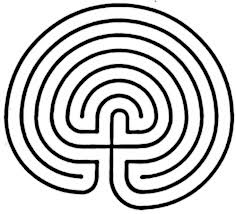 If you have not yet met the labyrinth, let me introduce it to you. It is good to know that the labyrinth is different from a maze, which has quite different qualities and descriptions. Nowadays there are many different forms and shapes, but the oldest labyrinth is called the classical or Cretan labyrinth. The oldest datable labyrinth has been scribbled on the back of a Greek clay accounting tablet over three thousand years ago. Before that, the origin of the labyrinth becomes more and more indistinct. By their nature, the labyrinth and labyrinthine petroglyphs, as found in Val Camonica (Italy) or Galicia (Spain), are difficult to date scientifically. Educated estimates could be three, four, five thousand years BCE.
It is not known when, how or why the labyrinth came into existence. It may have been inspired by the spiral forms that can be found all around and even inside us: on a snail-shell, a fern unfolding, the great arms of the galaxy; and fingerprints, intestines, brain structure, they too show a certain spiraling and meandering flow. Another origin of the labyrinth could be sacral dance. Footsteps left imprinted in the sand or on the grass after a dance around a sacred fire may have been the early start of a labyrinth. We simply do not know for certain.
The labyrinth has been found near caves and mounds, on doorways and thresholds. It is regarded as a protective symbol, guarding and connecting the inner and outer worlds. Today, the labyrinth is predominantly considered to be a representation of the path of life. It is walked in meditation or prayer, for inspiration, dedication, consolation. For many who walk it, the labyrinth has become a place where one can regain one’s balance, where the mind can relax, where the intuition can be heard, a place where a connection with the divine can be made.
Drawing excerises
You can find better drawings and instructions on the internet of how to draw a lauburu or the classical labyrinth. However, to get you started, here are my drawings.

Draw the lauburu, with compass

Draw the classical labyrinth, with seed pattern
Key to lauburu, key to labyrinth
After my first research I got back to my friend and asked him about the connection between the lauburu and the labyrinth. He gave me an assignment: “Here is a game to see if you can figure some of it out for yourself. Start by drawing the nine turning points of the labyrinth in an X shape. The four outer points represent the rich people’s houses. The four inner points represent the poor people's houses. At the central crossing point there is a well for water. The aim is to build one continuous wall, so that the rich people have access to the well, but the poor people do not.”

Before continuing to read, go ahead and try the exercise for yourself.
[relaxing background music with a splash of nature sounds while you do the exercise]
After some trying and playing, this was my final drawing:

Tadaah! Here is a connection between lauburu and labyrinth! Of course, I can't say the connection, as I am certain there is much more to discover here. I mean, just look at the Cantabrian lábaru below, that I got sidetracked by while researching the lauburu. It is very reminiscent of the classical labyrinth seed pattern. How intriguing is that!
There is more to find and more dots to connect. But first, this story continues with the lemniscate symbol, as while I was doing the drawing excersises, I stumbled upon the lemniscate in the labyrinth.
CW/summer20-summer25
Sources:
- Legend of Mari and the lauburu found on https://www.amaiur.net/lauburu-vasco/
- Interesting read about the Cantabrian lábaru, or Cantabrian labarum (military standard): https://en.wikipedia.org/wiki/Cantabrian_labarum + https://herenciaytradiccion.blogspot.com/2012/02/el-lauburu-vasco-es-el-labaro-cantabro.html

Cantabrian lábaru
/ | \